
|
|
|
Back to Building Historical Musical Instruments |
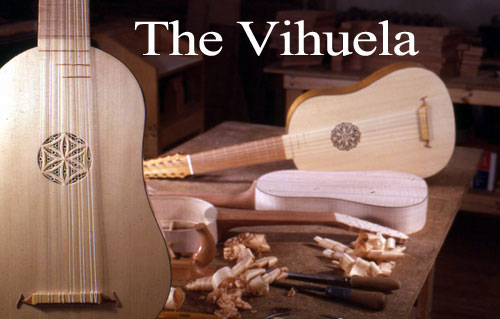
Building a Spanish Vihuela
When planning out an instrument, care must be taken not to slavishly imitate surviving instruments since these are rarely an accurate representation of the instruments actually used by professional and serious amateur musicians in any given era. Typically, the more ornate instruments survived and the plain ones were either rebuilt into something else or discarded. There are only four surviving instruments that are considered to have been vihuelas - the well-known example in the Musée Jacquemart-Andrée, the very enigmatic instrument in the Iglesia de la Compañiz de Jesús de Quito, in Quito, Ecuador, and the recently re-discovered 'Chambure' instrument in the Cité de la Musique (with a deeply fluted back). A fourth instrument, the 1581 Belchior Dias guitar in the Royal College of Music, London, is now considered by some luthiers to have been a vihuela at one point in its life. It also has a deeply fluted back. (See The Belchior Diaz Vihuela) The first two instruments I mentioned may not actually be vihuelas, but six-course guitars from a later period. This has never been settled and probably never will be.
Since there are only three surviving instruments that appear to be vihuelas, a lot of decisions have to be made about which features to include and which to ignore. To produce a really successful vihuela, the maker must be familiar with the music and the demands of the composers. Fortunately, vihuela music exists in tablature (which is less ambiguous than modern notation) and there are some fairly clear early books about performance practices1. You would not, for instance, build a vihuela with 8 or 10 courses since no music exists for this configuration. You might not want to use wound base strings on a vihuela because it increases the sustain of the low notes. A quick decay increases the ability of the performer to bring a high degree of subtlety and expressiveness to the varied voices of the polyphonic vihuela music. A long decay in the base makes the sound muddy, overpowers the trebles, and results in textures that are less clear. Some customers insist on wound strings anyway, because they are used to the sound and because twisted gut bases are quite expensive. Modern builders are forced to make concessions in response to market forces--a poor argument for building unauthentic instruments, but there it is. I am so glad that I no longer build professionally and have to reconcile the demands of historical accuracy with the needs of modern players! Almost all instrumental music is composed with the sounds and capabilities of the instrument in mind. A composer and performer will milk the instrument for all the tone colors and expression that he can get from it. If any part of the instrument is modernized, the modern performer may not be able to rediscover the sounds and textures that early composers found so exciting and exploited in their music. When I was at the Royal Academy studying lute, Diana Poulton used to explain that the vihuela replaced the lute in Spain in a very short time. When the Moors were driven out of the Iberian Peninsula, it suddenly became politically incorrect, if not dangerous, to play a Moorish instrument. The lute vanished and was replaced by the vihuela. Coincidentally, the description of the court musicians in Spain described in the 1480’s as lutenists changed almost overnight to vihuelists by 1500.
Many cities and towns in the Middle Ages and Renaissance had strict guild systems and an instrument maker would not have made his own pegs, unless he wanted to see a picket line in front of his shop. He would have bought his pegs from the wood-turners guild. I really enjoy making my own pegs because I can reproduce whatever historical design I want, but sometimes I wish I could just buy them somewhere. So far, I haven't found a shop called Pegs-R-Us.
I build the viola da mano and Spanish vihuela under the assumption that in the 16th-century they were built by lute makers, and that they would have used the same soundboard thicknesses and bracing patterns that they used for 6-course lutes since these also played highly polyphonic music and the makers knew what kind of sound they could get with those configurations. Until more research answers this question, I prefer to use the music as a final guide rather than the three surviving instruments and contemporary artwork, the interpretation of which is littered with pitfalls. This was also a period in which musical taste and playing styles changed rapidly. Robert Barto taught a course in vihuela technique at the LSA seminar in Cleveland last year, emphasizing the rapidity of the “dedillo” technique, as if it were a super-fast run, used with a bit of rubato. It was very convincing when he played some of the vihuela pieces with it. You can hear it HERE on You Tube. 1For a more complete investigation of original performance practices see: Griffith, John 1997--The Vihuela: Performance Practice, Style and Context, Performance on Lute, Guitar and Vihuela: Historical Practice and Modern Interpretation Cambridge University Press. ISBN 0 521 45528 6 |
| About Us | Music Samples | Our Instruments | Instrument Making | Calendar | Contact | Links | Home | Sitemap |
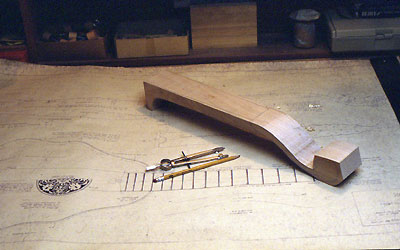 Building any instrument starts with a good set of plans. I either draw these myself or acquire a set of plans from a museum or another instrument maker. Shown is a plan for an orpharion.
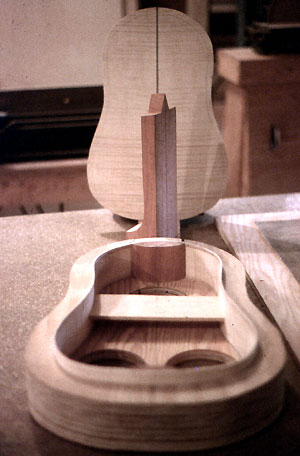 An outside form (a form that surrounds the instrument on the outside) allows more control over the dimensions than an inside form. For larger instruments, like base viols, an inside form is a little more convenient. The neck with its typical reverse dovetail joint, and the back of the vihuela can be seen in the background.
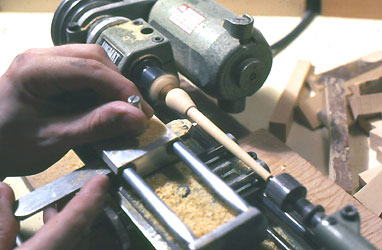 Pegs are made with a pattern follower on a small Unimat metal lathe. Patterns are set on the front edge of the pattern follower (the device with two rails) and a stylus follows the pattern and reproduces it in wood.
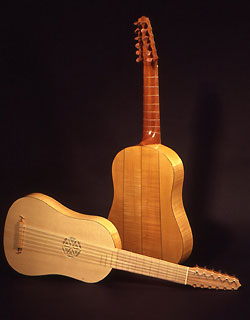 I build my vihuelas
with no inlay on the soundboard, even though surviving instruments and
much of the early iconography shows inlays. What 16-th century art does
not reveal is whether these details were painted on the soundboard (look
at all the Amati's and Strad's with ornamentation painted on the instrument)
or inlaid into the soundboard with other types of wood. The problem with
doing inlays is that you have to make the soundboard a lot thicker to
accommodate them, and this changes the sound of the instrument.
I build my vihuelas
with no inlay on the soundboard, even though surviving instruments and
much of the early iconography shows inlays. What 16-th century art does
not reveal is whether these details were painted on the soundboard (look
at all the Amati's and Strad's with ornamentation painted on the instrument)
or inlaid into the soundboard with other types of wood. The problem with
doing inlays is that you have to make the soundboard a lot thicker to
accommodate them, and this changes the sound of the instrument.