|
|
|
Back to Building Historical Musical Instruments |
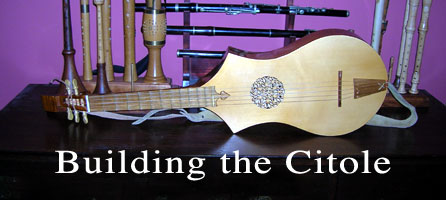
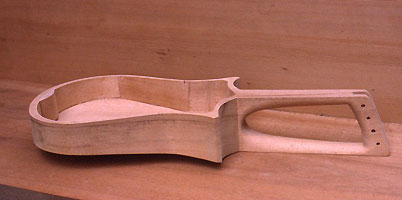
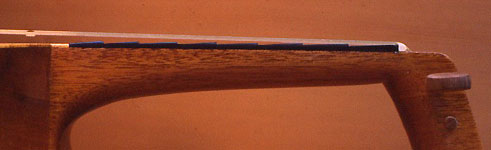
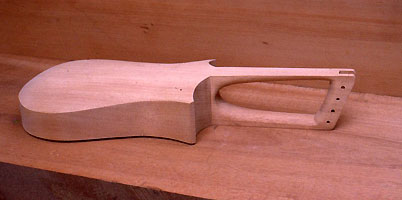
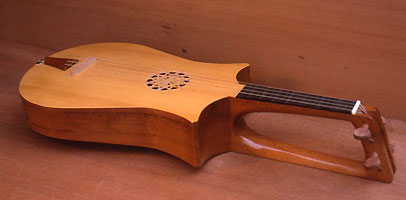
Building the Medieval CitoleThe body and neck of the medieval citole was carved from a solid block of wood. For this citole I used a block of mahogany 4 inches thick. The soundboard was glued on separately. Owing to the unreliability of glues during the middle ages, this construction technique would have resulted in an instrument that didn't come apart very often. I built the citole at right in this style, with a traditional "thumbhole" style of neck. This citole was strung with four gut strings and is played with a plectrum. The stepped fingerboard is made of small blocks of wood glued on separately. Each block is wedge shaped, higher at the body end to make a "fret". Modern metal frets would not be an "improvement". Anachronistic additions to early instruments often create other problems, including a sound that is not typical of the period. I am more interested in building instruments as closely as possible to what was used in the Middle Ages or Renaissance, and then discovering what can be done with them. |
 |
 |
 |
 |
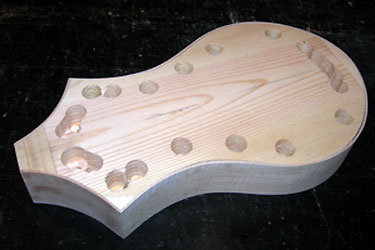 By about 1500, citoles in Italy were made by making the sides and back separately and gluing them up. Unibody citoles were now less common, in favor of much lighter instruments with glued-up ribs. I built the citole at left in the later style on a solid mold. Here the sides have been bent, clamped to the mold and glued to the end blocks. In addition to building the instrument from separate back, sides, and neck, the Italians experimented with metal strings on it. For this reason, the citole has been proposed as the ancestor of the renaissance citterns since the cittern was strung in metal. I think it's a mistake to suggest that the citole "evolved" into the cittern. As an instrument maker, I am convinced that the Italian makers were inspired by the citole to build some other types of plucked string instruments, and that the cittern was invented independently. I have already pointed out, in this website, that instruments did not "evolve" or even "improve" in the Darwinistic sense. Rather, instruments were changed to suit changing fashion and taste in music and the demands of musicians for instruments that could express the changing styles of music. Instrument makers would have experimented with different shapes, string lengths, string materials, soundboard materials, etc. in order to fully explore their craft, but the ultimate goal would have been to satisfy the demands of the marketplace--the musicians who were creating new music. 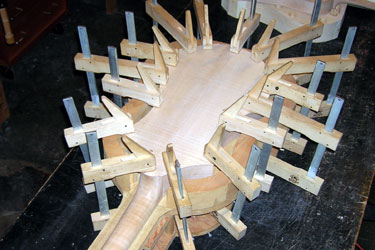 The back is glued to the sides. In spite of all the clamps, the pressure is kept very light to avoid a starved joint (squeezing out so much glue that the joint fails).
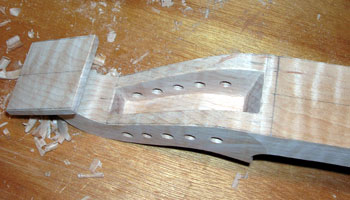 This citole will have five single strings. An exhaustive study of medieval and early Renaissance iconography showed citoles with anywhere from four strings to twelve strings, sometimes in pairs. String numbers are calculated by counting pegs, not strings, since the medieval artist didn't usually paint in the strings very well.
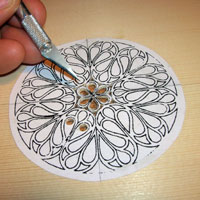
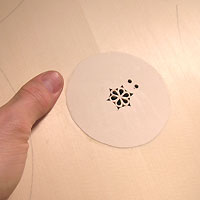
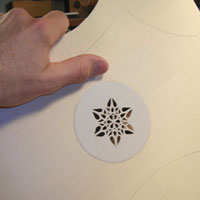
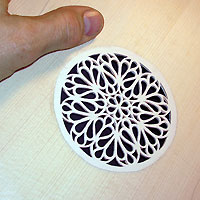
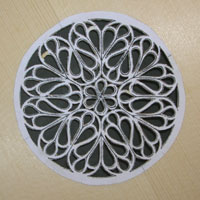
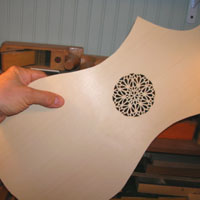
Steps in carving the rose, showing both front and back. The paper will be left on the inside of the soundboard to support the fragile rosette. It will be sanded off the top.
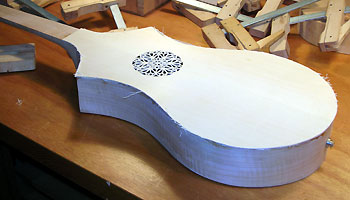 The soundboard is glued onto the sides. The neck has already been attached to the body, but the fingerboard has yet to be glued on. 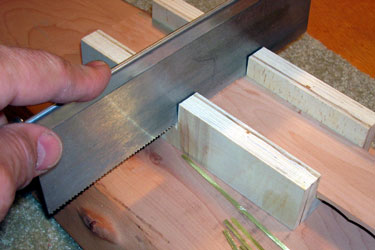 I made a small miter-box exactly the width of the fingerboard to cut the slots for the brass frets. 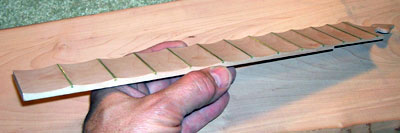 Brass bar stock was glued into the slotted fingerboard and the wood is scalloped between the frets, which were set in flush with the top of the fingerboard. The scalloping eliminates buzzing. This is how some cittern fingerboards were constructed. The Renaissance cittern is one of the descendents of the citole, although this does not mean that the citole "evolved" into the cittern. It just means that it came earlier. 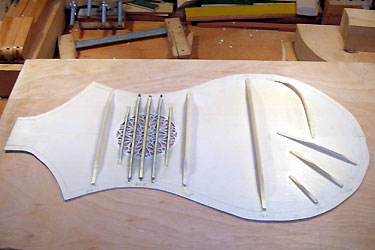 I glued bracing on the soundboard in a simplified version of lute bracing. There are no surviving citoles so I just decided to think backwards for the bracing pattern and guess how a luthier in early Renaissance Italy would have done the bracing. 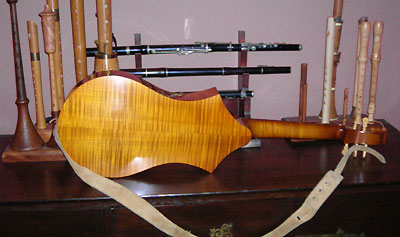 I used a reddish-brown varnish on the back and sides, and a lighter brown varnish on the soundboard (see photo at top of page). 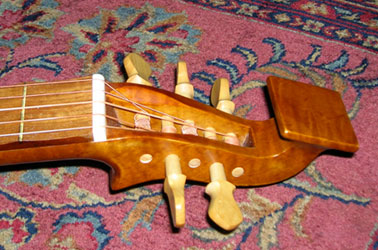 I turned the pegs in a shape that echoes the body shape. The pegs are made from English boxwood. |
| About Us | Music Samples | Our Instruments | Instrument Making | Calendar | Contact | Links | Home | Sitemap |
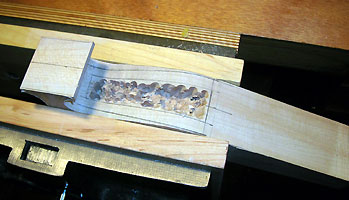 The citole pegbox is drilled out before being carved with a chisel.
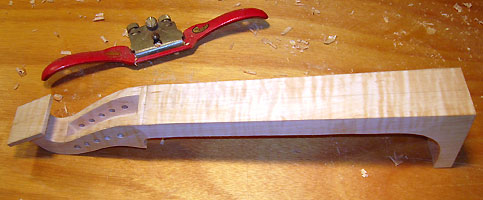 The neck and pegbox are cut from a single piece of figured maple.
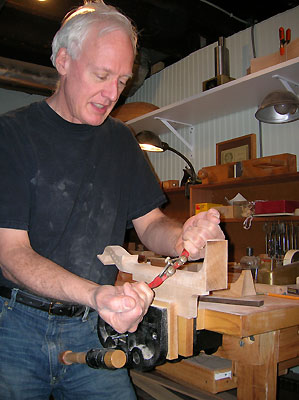 Brute force carving with a spokeshave. A quick way to remove a lot of wood by hand.